



Indigenous History Month: Honouring the Lands, Peoples, and Histories that Shape This Province
By Kahla Yzerman | June 2025
June is Indigenous History Month in Canada, and across the nation we are honoured to take time to learn and recognize the profound histories, cultures, and contributions of First Nations, Inuit, and Métis peoples. In British Columbia, over 200 distinct First Nations have lived on these lands since time immemorial, each with their own languages, laws, and traditions.
At BC’s Guide to Arts and Culture and on Art-BC.com, we’re highlighting historical museums and cultural centres across several BC regions. These sites are places where Indigenous history is not only remembered but actively preserved, taught, and shared through permanent exhibitions, preserved historical sites, workshops, and events throughout the year. Each site is an intentional space showcasing the histories and cultures of the Nations on whose land they stand.
Sea to Sky Region
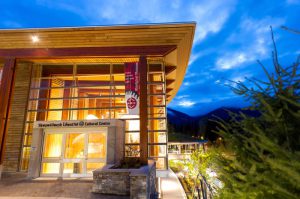
Sḵwx̱wú7mesh (Squamish), Líl̓wat7úl (Lil’wat) Cultural Centre
Unceded territories of the Sḵwx̱wú7mesh (Squamish), Líl̓wat7úl (Lil’wat), and shíshálh (Sechelt) Nations
The Sea to Sky region, globally known for its natural grandeur, stretches from the Strait of Georgia to the alpine ranges of Whistler. This is the ancestral home of the Sḵwx̱wú7mesh, Líl̓wat7úl, and shíshálh peoples, whose cultures remain deeply rooted in these lands. These Nations continue to uphold their rights and responsibilities through governance, cultural resurgence, and language revitalization.
- Squamish Lil’wat Cultural Centre (Whistler)
This centre is an intentional space designed, built and maintained by the distinct Squamish and Lil’wat Nations to celebrate and share their living cultures. Through permanent exhibits, traditional carvings, multimedia displays, and guided tours, it offers a powerful account of the land’s original stewards and the vitality of their interconnected histories with archeological records dating back to over 8000 years ago, and oral histories of place. - Audain Art Museum (Whistler)
The Audain Art Museum, while primarily focusing on British Columbian art, houses an important collection of Indigenous historical masks and artworks. Michael Audain and Yoshiko Karasawa have a long-standing, respectful relationship with the Squamish and Lil’wat Nations, on whose unceded territory the Audain Art Museum stands. The museum was designed in close conversation with these Nations to honour local cultural protocols and the significance of the land. Its permanent collection features outstanding historical works from Indigenous Nations across the Northwest Coast including Haida, Gitxsan, Kwakwaka’wakw, Nisg̱a’a, Tsimshian, and Coast Salish, preserving and showcasing ancestral knowledge and ceremonial artistry.
- Tems Swiya Museum (Sechelt)
Operated by the Shíshálh Nation, Tems Swiya (“Our World”) houses archaeological re-discoveries, regalia, carvings, and photographs that document and honour thousands of years of local Indigenous history. The museum plays a vital role in preserving Shíshálh identity through ongoing community storytelling and repatriation efforts.
Vancouver Island

U’mista Cultural Centre | photo: Destination Indigenous
Home to many Coast Salish, Nuu-chah-nulth, and Kwakwaka’wakw Nations
Vancouver Island’s Indigenous history is shaped by what archaeologists have dated as at least 13,800 years of complex coastal lifeways, governance systems, and ceremonial traditions such as the potlatch. The Island is home to three major cultural groups: the Coast Salish, whose territories span the southeastern Island and Gulf Islands (including the Lək̓ʷəŋən, Songhees, and Esquimalt Nations around Victoria); the Nuu-chah-nulth, whose territories stretch along the Island’s rugged west coast from Barkley Sound to Kyuquot; and the Kwakwaka’wakw, whose territories are found on the northeastern tip of the Island and adjacent mainland inlets. These Nations maintain enduring relationships with ocean and forest ecosystems, despite the deep disruptions of colonial settlement. Today, their histories continue to be taught, protected, and revitalized through community leadership and cultural centres across the region.
- Royal BC Museum (Victoria) Located on the territory of the Lək̓ʷəŋən (Songhees and Esquimalt) Nations, this provincial museum houses significant First Peoples exhibits, featuring carved house posts, bentwood boxes, and oral histories. The museum has played a key role in public education around Indigenous governance, trade, and traditional technologies, especially for visitors to British Columbia.
- Museum at Campbell River This museum showcases the rich heritage of the Kwakwaka’wakw peoples through interactive displays, archival footage, and preserved artifacts. Its First Nations Gallery provides historical context on contact, colonial pressures, and celebrates the strength of contemporary cultural practices in the region.
- U’mista Cultural Centre (Alert Bay) An important site of cultural reclamation, the U’mista Cultural Centre in Alert Bay is one of BC’s longest-operating and most successful Indigenous cultural facilities. Founded in 1980, it was established to bring home and protect regalia confiscated during Canada’s potlatch ban; an act of cultural repression that deeply impacted the Kwakwaka’wakw peoples. The name U’mista means “the return of something important,” and the centre became a model for the repatriation of First Nations artifacts across the country. Today, U’mista operates a modern museum and cultural education centre, offering permanent and rotating exhibitions, tours, performances, and scholarly research support, telling a powerful story of ceremonial life, cultural resilience, and ongoing renewal.
Interior British Columbia
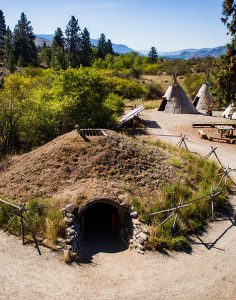
Pit House @Nk’Mip Desert Cultural Centre
Territories of the Secwépemc and Syilx (Okanagan) Peoples
The Interior of British Columbia is home to the Syilx (Okanagan) and Secwépemc (Shuswap) Nations, whose histories stretch back thousands of years. The Syilx are renowned for their expert stewardship of the Okanagan Valley’s abundant resources, including the vital waters of the Columbia River. The Secwépemc consist of 17 distinct communities spread across the Fraser, Thompson, and Columbia River regions, with a sophisticated social and political system that placed great importance on sustainable land and resource management. Despite facing challenges from colonial policies, land loss, and residential schools, both Nations continue to uphold their cultural traditions and governance, actively working to revitalize their languages, knowledge, and connections to their ancestral territories through the maintaining of cultural centres and historical sites across the region.
- Secwépemc Museum & Heritage Park (Kamloops) Nestled in the heart of Secwépemc traditional territory, the Secwépemc Museum and Heritage Park is a sacred space dedicated to preserving and celebrating the rich cultural heritage and traditional wisdom of the Secwépemc people. The museum serves as a bridge connecting past, present, and future generations through dynamic exhibits, engaging programs, and immersive experiences. Working closely with Secwépemc elders, knowledge keepers, and community members, the museum safeguards oral histories, language, art, and traditional land use knowledge. Visitors are invited to explore vibrant displays that reveal the deep spiritual, cultural, and ecological connections that have sustained the Secwépemc for centuries. The heritage park further offers a chance to experience the living landscapes central to Secwépemc identity, fostering understanding, respect, and cultural renewal.
- Nk’Mip Desert Cultural Centre (Osoyoos) Located in the heart of Canada’s only desert, the Nk’Mip Desert Cultural Centre is a powerful expression of Syilx Okanagan knowledge, resilience, and land stewardship. Designed to echo traditional winter dwellings, the centre is built into the hillside using rammed earth construction; honouring the land while modelling sustainability. Inside, visitors encounter archaeological exhibits, endangered species research, and repatriated cultural belongings. Operated by the Osoyoos Indian Band, the centre weaves together deep cultural roots, traditional and contemporary environmental science, and a thriving vision for Indigenous self-determination, where education, conservation, and histories of economic ingenuity and development are showcased.
Northern British Columbia
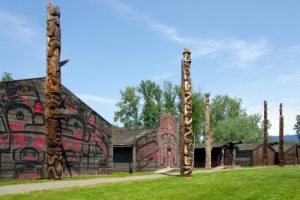
Ksan Historical Village
Homelands of the Tsimshian, Gitxsan, Nisg̱a’a, Haisla, and Tahltan Nations
Northern BC holds some of the most potent and continuous expressions of Indigenous sovereignty and culture in the province. The homelands of the Tsimshian, Gitxsan, Nisg̱a’a, Haisla, and Tahltan Nations are among the oldest continuously inhabited regions in North America. Archaeological evidence places Tsimshian presence along the lower Skeena River and Prince Rupert Harbour at over 10,000 years, with ancient village sites like Lax Kw’alaams revealing sophisticated fishing technologies and complex social systems. The Gitxsan and Nisg̱a’a, whose territories converge around the Nass and Skeena Rivers, have maintained vibrant clan governance and oral traditions for thousands of years, as seen in longhouse village remains and totemic histories carved into the landscape. The Haisla, based in Kitamaat Village near the Douglas Channel, have stewarded marine ecosystems and trade routes for millennia, with archaeological findings dating habitation in their territory to at least 6,000 years ago. Further inland, the Tahltan people of the Stikine River and Mount Edziza region have lived and traded in volcanic highlands for over 10,000 years, as evidenced by obsidian quarries and ancient campsites that supplied stone tools across the Pacific Northwest. From landmark treaties to preserved longhouses, these Nations assert their rights through language revitalization, governance, and care for the lands and waters they’ve inhabited for millennia.
- Kitimat Museum Situated on the traditional territory of the Haisla Nation, the Kitimat Museum offers an in-depth look at Haisla culture. Central to the museum is the Haisla Heritage Collection, displayed in the Upstairs Gallery, showcasing traditional tools, historical photographs, and stories that span both pre- and post-contact life, where artifacts held in trust for the Nation are presented in museum-quality cases. Nine accompanying panels, developed in collaboration with Haisla Elders, educators, and cultural advisors, offer insights into Haisla teachings (Nuyem), seasonal food harvesting, language, family stewardship areas (Wawais), and artistic practices, both traditional and contemporary.
- Museum of Northern BC Located on the traditional territory of the Tsimshian people, the Museum of Northern BC in Prince Rupert is housed in a longhouse-inspired building and holds one of the province’s most significant collections of Northwest Coast artifacts. Its exhibits offer a comprehensive portrait of Tsimshian life past and present, highlighting seasonal rounds, clan systems, potlatches, and the deep importance of oral tradition. Visitors can explore traditional practices of fishing, hunting, and gathering, as well as intricately carved totem poles, masks, and ceremonial objects that reflect the artistry and social structure of Tsimshian culture. Through interpretive tours, school programs, and curated exhibits, the museum fosters a deeper public understanding of Tsimshian heritage and the enduring presence of Indigenous knowledge in the region.
- Nisga’a Museum (Lax̱g̱alts’ap) Often described as “a feast for the spirit,” the Nisg̱a’a Museum—Hli Goothl Wilp-Adokshl Nisg̱a’a, or “The Heart of Nisg̱a’a House Crests”—showcases the cultural treasures of the Nisg̱a’a Nation, who signed British Columbia’s first modern land claim agreement. Located in Lax̱g̱alts’ap, 150 kilometres northwest of Terrace, the 929-square-metre space is inspired by traditional Nisg̱a’a longhouses, feast dishes, and canoes. At its core is the Ancestors’ Collection: a powerful gathering of masks, bentwood boxes, headdresses, and soul catchers that were originally acquired during the late 19th and early 20th centuries (and housed in collections across the country) returned home as part of the Nisg̱a’a Treaty. These culturally significant artifacts are now displayed together for the first time in their place of origin, embodying the Nation’s enduring governance, cultural power, and the sacred importance of repatriation.
- ‘Ksan Historical Village (Hazelton) Located at the confluence of the Skeena and Bulkley Rivers near the ancient village of Gitanmaax, the ‘Ksan Historical Village and Museum is a powerful site of cultural continuity for the Gitxsan people, who have lived in the region for over 8,000 years. This faithfully reconstructed Gitxsan village includes longhouses, carved totem poles, and interpretive exhibits that immerse visitors in the Nation’s deep social structures, oral histories, and spiritual knowledge. Through guided tours and traditional storytelling, visitors gain insight into Gitxsan laws (Ayookw), hereditary governance, and the vital relationship between Gitxsan people and their territories. The museum features artifacts, tools, and artistic recreations that reflect the ingenuity and artistry of past generations, while honouring the ongoing cultural resurgence of the Gitxsan Nation.
Indigenous History is Living History
These museums and cultural centres are not simply reflections of the past—they are living sites of resistance, remembrance, repatriation, and renewal. They celebrate the distinctiveness, enduring wisdom, and dynamic creativity of Indigenous Nations across these lands. During Indigenous History Month, we are invited to engage with these spaces thoughtfully, to learn from the sacred knowledge of British Columbia’s First Peoples, and to honour the deep histories and living presence of the land and its original stewards. To explore the diverse territories, languages, and cultures represented, visit the First Peoples’ Map of B.C.
