



by Kahla Yzerman
As autumn sets in, there is a particular kind of comfort that accompanies returning from summer adventure and exploration to familiar rhythms and settling back into the communities we call home. This year, that feeling carries particular weight.
Writing about what makes a community thrive feels especially tender in September of 2026, as communities across our province emerge from another difficult wildfire season. Summerland and its neighbours in the Okanagan, Okanagan Indian Band and the Greater Vernon area, communities throughout the Cariboo and Fraser Canyon, and many other First Nations, towns and rural regions have experienced evacuation, displacement and, in some cases, profound loss. Others have opened their doors and resources to neighbours forced to leave their own communities. A list of place names will inevitably miss the incredible nuance and impact experienced by all those affected in such times.
Nonetheless, an article about community well-being should begin with a heartfelt acknowledgement of the struggle, loss and uncertainty experienced by so many across our province this summer, as well as the many ways communities have gathered around one another in response. It is often in moments of great disruption that vital communal networks of relationship, care and togetherness become visible.
A community is, after all, much more than the place where we happen to live.
1. Arts, Culture & Community
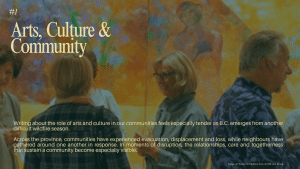
It is a constellation of factors, some conspicuous and public, and others the product of years of sustained investment in creating a sense of place. It begins with the land itself and the particular geography, ecology, climate, and natural systems that shape how and where we live. It is also cultivated through the decisions we make about how places are governed and built, the institutions and public spaces we collectively maintain, the relationships we nurture, and the ways we care for one another. But perhaps most significantly, community is shaped by the histories we inherit and wrestle with, the stories we tell, the traditions we carry forward, and the art we make in response to the places and people around us contributing to remembrance and transformation. In short, communities are shaped a relationship between land and culture.
2. Culture & Place
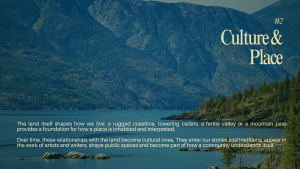
Geographical land influences the way of life of its inhabitants. The conveniences of contemporary life may insulate us from some of nature’s impacts and demands, but a rugged coastline, a forest of towering cedars, a fertile valley, or a mountain pass still provides an unmistakable foundation for how a place is inhabited and interpreted. Geography influences what is cultivated, the industries that emerge, the ways communities are built and connected, and what kinds of work and recreation respond to the land. Over time, these material relationships with the land become cultural ones as a community takes shape around it. They enter local histories and traditions, appear in the work of artists and writers, shape architecture and public spaces, and become part of a collective identity.
3. Culture & Collective Identity
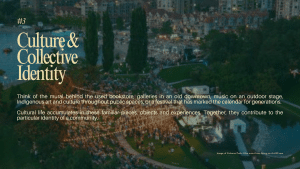
Picture a vibrant and thriving community. The mural behind the used bookstore where countless photos have been taken; the gallery spaces in the old part of downtown that feature the work of local artists; the outdoor stage where theatre and music performances draw a crowd; the Indigenous cultural presence woven throughout walking paths, public art, place names, and gathering spaces; the heritage building given new life as a studio or cultural centre; the summer festival that has marked the calendar for generations; the library, theatre, museum, market, and small independent businesses that become familiar points of encounter. In every way that culture appears, it forms the basis of a collective identity and according to several studies of communal well-being in British Columbia, art and culture play a significant role in the thriving of a healthy community.
4. Arts, Diversity & Connection
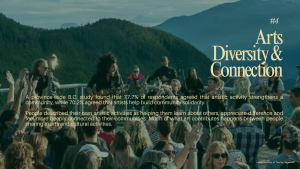
This relationship is illustrated by a province-wide study researching arts participation and community well-being in British Columbia. One study that drew from a diverse set of communities across BC found that 77.7% of respondents agreed that “artistic activity strengthens a community,” while 70.2% agreed that artists help build community solidarity.¹ Tellingly, the effects described by participants were relational: 74.6% said their artistic activities helped them learn about other people, 71.4% said they helped them accept differences among people and appreciate diversity, and nearly half reported that their artistic activities helped them feel more deeply connected to their community.¹ These findings should come as no surprise to cultural enthusiasts.
5. Culture & Meaning
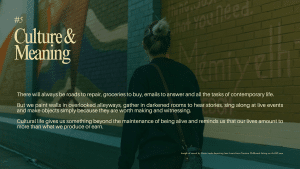
The significance of cultural life within our communities provides soul sustenance beyond the ordinary maintenance of being alive. There will always be roads to repair, groceries to buy, emails to answer, and all the tasks of contemporary life in BC. But, integral to our sense of well being individually and in community is remembering that we make things too. Painted walls in otherwise overlooked alleyways. Gathering in darkened rooms to listen to people telling us stories. Singing along at live events. Collecting hand made objects with no real use other than to adorn our shelves or simply to be witnessed. These things may not keep us alive, exactly, but they enrich, create meaning, create community and together, remind us that our lives amount to more than what we can produce or earn. Communities instinctively make space for culture because we share a collective desire for places to gather and share in the experience of witnessing something together.
6. Cultural Participation & Belonging
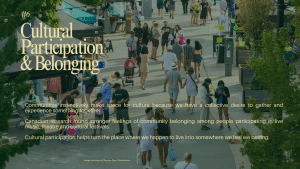
There is data behind this instinct, too. Hill Strategies Research drew on Statistics Canada’s General Social Survey of 9,844 Canadians to look at the relationship between cultural participation and health, mental health, life satisfaction, and that harder-to-quantify feeling of belonging somewhere—in community.² Across all 15 arts, culture, and heritage activities studied, participants were more likely to report very good or excellent health than non-participants; for 14 of those activities, the difference was statistically significant. The relationship with belonging was more nuanced, but particularly interesting when people gathered for live cultural experiences within their communities. Even after accounting for income, age, education, region, and other socioeconomic factors, people who attended live music or theatre and comedy were 20% more likely to report an above-average sense of belonging to their community, while arts and cultural festival attendees were 13% more likely.² It is clear that there is something about gathering together around and experiencing cultural activity in the company of other people that helps turn the place where we live into somewhere we feel we belong.
7. Culture & Intergenerational Knowledge
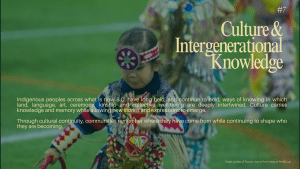
This understanding of culture as integral to collective well-being is hardly new. Long before contemporary research began to measure the relationship between cultural participation and health, Indigenous peoples across what is now British Columbia held, and continue to hold, ways of knowing in which culture, land, language, art, ceremony, kinship and collective well-being are deeply intertwined. Contemporary Indigenous scholarship continues to make visible what communities have long known and lived. The National Collaborating Centre for Indigenous Health, based at the University of Northern British Columbia, describes First Nations, Inuit and Métis health and well-being as closely tied to “land-based experiences, cultural practices, artistic expressions, and Indigenous language use and revitalization.”³ Ongoing research continues to connect cultural continuity and revitalization with stronger individual and collective well-being. Culture, in this understanding, is not an superfluous within a healthy community. It is one of the ways a collective comes to know itself, remember itself, relate to the land, and continue to build intentionally toward a collaborative future.
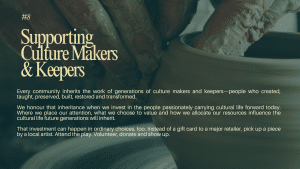
Every community inherits cultural traditions and contributions and artifacts that carry the story of diversity, investment and interconnectedness. The art, stories, traditions, gathering places and cultural institutions that give our communities their particular character are the accumulated work of generations of culture makers and keepers—people who created, taught, preserved, built, restored and transformed. We honour that inheritance when we invest in the people passionately carrying cultural life forward in our communities. Where we place our attention, what we choose to value, and how we allocate our time and resources continue to influence the cultural life taking shape around us, and ultimately, what future generations will go on to inherit from us.
8. Supporting Culture Makers & Keepers
Investment in the sustainable thriving of community arts and cultural initiatives can take many forms. Protecting cultural spaces and funding arts organizations, advocating for arts education and cultural appreciation, and continuing to advocate with local governments to recognize the cultural sector as a vital aspect of community health. Investing can also exist within our ordinary choices. Instead of a gift card to a major retailer, pick up a piece by a local artist. Attend the play. Volunteer, donate, and show up. Take your children to festivals and cultural events where they can hear and see the stories of artists, and experience the cultural wisdom and knowledge of the people whose lands we inhabit. Learn the names and stories of the artists, performers, cultural workers, knowledge keepers, curators, organizers and volunteers working in your community today. Engaging with arts and culture can enrich not only your own experience of meaning, but invite you to become part of strengthening community ties and shaping a collective cultural identity in which interdependence, belonging and an instinct for mutual flourishing can take root.
9. Cultural Roots & Resilience
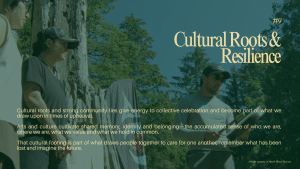
Cultural roots and strong community ties give energy to collective celebration, and become what we draw upon in times of unexpected upheaval. In a year when communities across British Columbia have once again been tested by a harrying wildfire season, we have also seen how deeply people draw together when the places they call home are threatened. The instinct to gather, care for and protect is strengthened by how we participate and experience a shared identity. A shared sense of belonging and cultural footing gives visible form to accumulated knowledge of who we are, where we are, what we value, what we remember, and what we hold in common. It is the thread that draws neighbours, organizations and small businesses into the larger tapestry of a community. Arts and culture cultivate intergenerational memory, identity and experience, while continually making room for new stories and new ways of belonging. When circumstances disrupt our lives, those relationships and cultural roots are what grounds a community and inspires us to care for one another, remember what has been lost, and imagine the future.
