



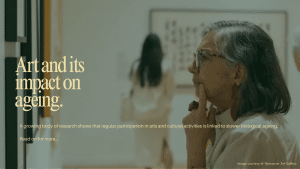
Art and it’s Impact on Ageing
by Kahla Yzerman, August 2026
Think of the last time you sat in a seat, facing the stage, immersed in a performance. The way that time disappeared as you worked out a new song on the guitar, or the whiling away of the hours as you mixed paint to capture the colours of the sunrise over your favourite mountain view. We are all familiar with the autotelic experience—or, in plain English—losing track of time.
Autotelic comes from the Greek root meaning essentially “having its end in itself.” An autotelic experience is something you engage in and pay attention to because the experience itself is rewarding, rather than primarily focusing on a specific outcome.
So attending a concert, play, dance performance, opera, or reading can be autotelic when you are there simply for the experience of attending, listening, watching, feeling, and being absorbed. You aren’t trying to learn something, network, produce something, document it, or otherwise convert the experience into a useful or productive result. Similarly, a creative pursuit becomes an autotelic experience when you enjoy being immersed in the process.
Whatever your version of creative enjoyment, the time-disappearing quality creates a kind of temporal distortion similar to that of being in a flow state. But what if the creative immersion of mind, body and attention really does slow time?
A growing body of research shows that regular participation in arts and cultural activities is associated with healthier ageing—and recent research suggests that relationship may extend to the biological markers of ageing itself.¹
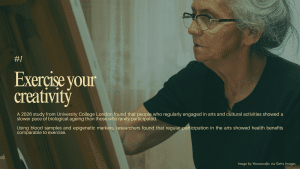
1. Exercise your creativity
A 2026 study from University College London and published in Oxford’s Innovation in Aging examined survey data and blood samples from 3,556 adults in the UK, using seven epigenetic clocks to compare arts and cultural engagement with biological age and pace of ageing. Researchers found that people who engaged in arts and cultural activities more frequently, and participated in a wider variety of them, showed signs of slower biological ageing than those who rarely participated.¹
On one measure (DunedinPACE), people who engaged in an arts activity at least once a week showed a 4% slower pace of ageing than those who participated fewer than three times a year. Another (PhenoAge) highlighted that participants who engaged in arts and cultural activity weekly were biologically about one year younger, on average, than those who rarely participated. The apparent effects were comparable in magnitude to those associated with weekly exercise, and the relationships remained after researchers accounted for factors including BMI, smoking, education and income.¹
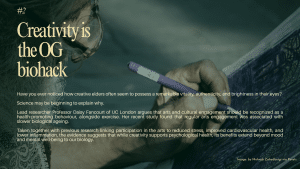
2. Creativity is the OG biohack
Have you ever noticed how creative elders often seem to possess a remarkable vitality, authenticity, and brightness in their eyes?
Science may be beginning to explain why.
Lead researcher Professor Daisy Fancourt of University College London argues that arts and cultural engagement should be recognized as a health-promoting behaviour, alongside exercise. Her recent study provides some of the first scientific evidence that our engagement with culture may register at a biological level.¹
And the relationship may extend to the ageing brain. In a 10-year study of adults aged 50 and older, researchers found that visiting museums every few months or more was associated with a lower incidence of dementia than less-frequent attendance, even after accounting for demographic, socioeconomic and health factors.² The researchers point toward the idea of cognitive reserve: mentally engaging, enjoyable and socially interactive activities may help build resilience against cognitive decline as we age.²
Taken together with previous research linking participation in the arts to psychological, physiological, social and behavioural pathways that influence health, the evidence suggests that creativity reaches well beyond mood and mental well-being. A major World Health Organization review examining more than 3,000 studies found evidence for a role for the arts in the prevention of ill health, promotion of health, and management and treatment of illness across the lifespan.³
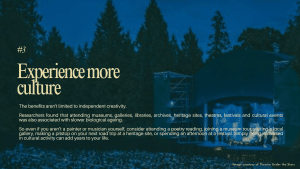
3. Experience more culture
The benefits aren’t limited to independent creativity.
Researchers have also studied what they call receptive arts engagement: going to museums, galleries, exhibitions, theatres, concerts and opera.⁴
And this isn’t the first time researchers have found a relationship between simply showing up for the arts and longevity.
In a 14-year study of 6,710 adults over 50, researchers found that people who attended museums, galleries, exhibitions, concerts, theatre or opera once or twice a year had a 14% lower risk of dying over the following 14 years than those who never participated. Those who attended every few months or more had a 31% lower risk of dying over that same period, even after researchers accounted for a wide range of demographic, socioeconomic, health, behavioural and social factors.⁴
The nature of the study was observational, so it’s findings cannot prove that attending the theatre will make you live longer, but it does place cultural engagement among a fascinating collection of behaviours associated with longevity.⁴
So even if you aren’t a painter or musician yourself, consider attending a poetry reading, joining a museum tour, visiting a local gallery, making a pitstop on your next road trip at a heritage site, or spending an afternoon at a festival. Simply being immersed in cultural activity may be one of the habits associated with living a longer, healthier life.
4. Hone your creative habits
We all attend a concert now and again, but, as with other forms of health-promoting behaviour, frequency appears to matter. In the 2026 biological-ageing study, researchers found a dose-response pattern: engaging with the arts at least three times a year was associated with a 2% slower pace of ageing, monthly engagement with 3%, and weekly engagement with 4%, compared with participating fewer than three times a year.¹
So what makes arts and culture so potent within our lives that are increasingly organized according to the temporal demands of a capitalist framework of work, productivity, and consumption?
A concert can stimulate the mind, regulate emotion, move the body, create social connection and give us something beautiful to anticipate, all within the same evening. Visiting a gallery exhibition exposes us to alternative or surprising perspectives, beauty, wonder and sustained focus. Researchers describe arts engagement as multimodal for precisely this reason: an arts experience can involve psychological, physical, social and behavioural processes simultaneously.⁴ Fancourt’s recent research similarly suggests that variety may matter because different forms of arts engagement offer different combinations of physical, cognitive, emotional and social stimulation.¹
5. Generate & participate
For those of us who are naturally drawn to arts and cultural experiences, the almost alchemical nature of what is described in these studies comes as no surprise.
For centuries, alchemy was preoccupied with transformation, restoration and the possibility of extending human life. We may not have found an elixir of life, but the imagined impact of such a body of research suggests that creativity is not a fleeting intervention, but a sustaining force with the benefits of restoration and holistic well-being. One that, when woven into the rhythm of daily life impacts how we endure, adapt, and age. So why not pencil it in?
This research adds to a substantial body of evidence showing that arts and culture contribute to healthier lives and healthier communities in innumerable ways. The World Health Organization’s review of more than 3,000 studies encompassed research ranging from small-scale studies and community ethnographies to nationally representative longitudinal studies and randomized controlled trials.³
On whatever scale, one thing is clear: when we create, perform, gather, volunteer, attend, mentor, collect, invest, preserve, or simply show up, we become participants in the generative work of culture.
In a world constantly selling products for anti-ageing, longevity, and biohacking our way to health, perhaps the greatest investment of our focus, energy, and resources is in one of the oldest forms of human flourishing: making, sharing, and participating in culture together.
Programs and Resources:
For the seniors in our midst: many cultural organizations offer discounted admission for older adults, and initiatives like the Vancouver Art Gallery’s Art at Any Age are happening all over the province, intentionally creating spaces where seniors can gather, engage with contemporary art, and build community through shared cultural experiences.
References
1. Fancourt, D., Bu, F., et al. (2026). Study of arts and cultural engagement and epigenetic biological ageing, Innovation in Aging. University College London, “Engaging with arts linked to slower pace of ageing,” 11 May 2026.
2. Fancourt, D., Steptoe, A., & Cadar, D. (2018). “Cultural engagement and cognitive reserve: museum attendance and dementia incidence over a 10-year period.” The British Journal of Psychiatry, 213(5), 661–663.
3. Fancourt, D., & Finn, S. (2019). What is the evidence on the role of the arts in improving health and well-being? A scoping review. Health Evidence Network Synthesis Report 67. Copenhagen: WHO Regional Office for Europe.
4. Fancourt, D., & Steptoe, A. (2019). “The art of life and death: 14 year follow-up analyses of associations between arts engagement and mortality in the English Longitudinal Study of Ageing.” BMJ, 367, l6377.
