




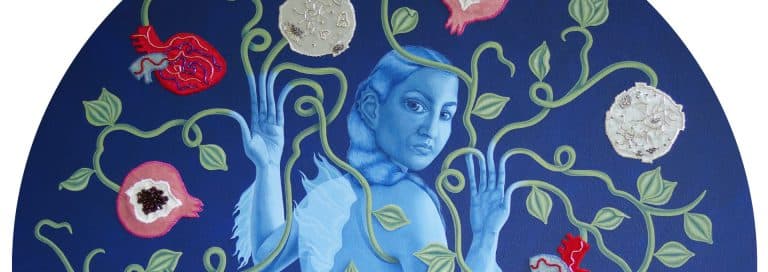
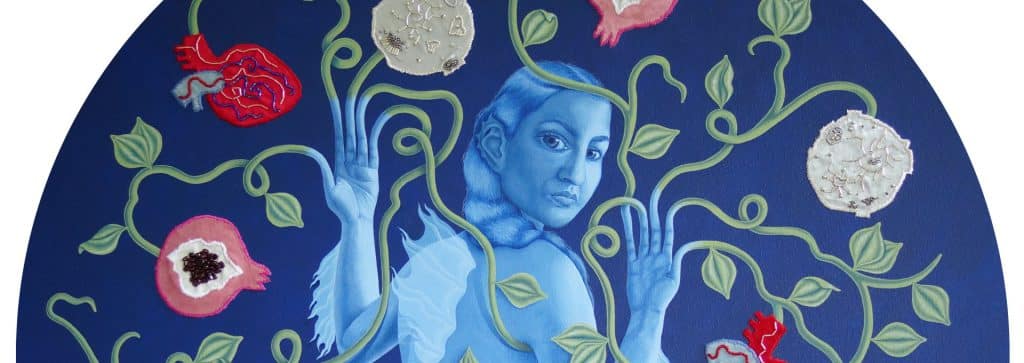
Kaur’s practice unfolds within the lived realities of the South Asian diaspora, where culture is shaped by movement, memory, and re-telling. Working across painting, sculpture, digital media, embroidery, poetry, and performance, Kaur draws from Sikh and broader Indic poetic traditions—ways of thinking and making in which metaphor and image are used to hold ways of living and understanding. Within Sikh culture, such imagery has long offered guidance: poetic forms and natural elements are used to reflect on humility, devotion, balance, and relational responsibility.
Kaur uses a recurring set of motifs that appear across materials and scales. The moon gestures toward cycles of time, discipline, and return, echoing Sikh understandings of attunement to larger rhythms beyond the self. The heart appears as both a bodily organ and a site of feeling and devotion, foregrounding sincerity and inner alignment. The pomegranate, dense with seeds, speaks to abundance and interconnection, resonating with communal values and diasporic networks of care. The lotus, rising from muddy water, reflects principles of humility and steadfastness—remaining grounded while moving through worldly conditions.
If Gardens Could Dream invites the viewer to consider the garden as more than a place—it becomes a living archive of memory, language, and belonging. Her work traces the journeys of stories, seeds, and cultural knowledge across generations and geographies, reminding us that marginalized communities take root in many places while remaining connected to ancestral lands. Surrey is an apt place to show Kaur’s work where so many histories of migration, care, and cultural exchange continue to shape the city’s landscape.
This exhibit grows out of Kaur’s 2023 exhibit Panjabi Garden, also on view, building on her engagement with Panjabi and Gurmukhi scripts. The title itself reflects a commitment to linguistic specificity and decolonial practice. “Panjab” derives from the Farsi words panj (five) and ab (water), referring to the five rivers that shape the region. By using “Panjabi,” Kaur returns to a linguistic form that foregrounds cultural and historical context.
Sorry, no records were found. Please adjust your search criteria and try again.
Sorry, unable to load the Maps API.
